AI Strategy Compass Framework
The AI Strategy Compass is a strategic framework developed by Martin Sattrup Christensen that helps organizations build and implement an AI strategy by aligning five critical dimensions: strategy, digital foundation, organization, solutions and scaling. The framework enables companies to move from AI experimentation to structured implementation and measurable business value.
What the AI Strategy Compass Helps Leaders Do
The AI Strategy Compass helps leadership teams turn artificial intelligence from a topic of discussion into a structured management discipline.
Instead of treating AI as isolated technology initiatives, the framework helps organizations:
- connect AI initiatives directly to business strategy
- build the digital and organizational capabilities required for AI
- identify and prioritize high-value AI use cases
- integrate AI solutions into everyday operations
- scale successful initiatives across the organization
By focusing on these five areas, the AI Strategy Compass enables companies to move from AI experimentation to structured implementation and sustainable business value.
Why the AI Strategy Compass Was Created
The AI Strategy Compass was developed to address a challenge that many leaders face when working with artificial intelligence.
In conversations with executives, board members and leadership teams, a common pattern emerges. Organizations recognize the importance of AI, but they often lack a clear structure for how to approach it.
Many companies start with isolated experiments, pilot projects or technology initiatives. While these activities can create learning, they rarely lead to sustained business impact without a broader strategic framework.
The AI Strategy Compass was therefore developed to help leaders approach AI as a leadership discipline rather than a technology project.
The framework provides a structured way to connect:
- business strategy
- digital capabilities
- organizational readiness
- AI use cases
- operational implementation
By bringing these elements together, the AI Strategy Compass helps organizations move from AI curiosity to structured AI strategy and implementation.
The framework is based on practical leadership experience and insights from organizations working to integrate AI into their operations.
AI Strategy Compass – A Framework for AI Strategy and Implementation
Artificial intelligence is transforming how companies compete, operate and create value. Yet many organizations struggle to move from experimentation to real results.
Many companies launch AI pilots, experiment with tools or run isolated projects. But without a structured framework, these initiatives rarely translate into lasting business value.
The AI Strategy Compass is a practical framework designed to help leaders turn AI from a vague ambition into structured action.
Instead of focusing on technology alone, the AI Strategy Compass framework focuses on the five areas that determine whether artificial intelligence creates real business value.
The Five Dimensions of the AI Strategy Compass Framework
The framework is built around five interconnected dimensions.
Together they form a structured approach to building and implementing an AI strategy.

-
Strategy

AI must support the overall business strategy.
Many organizations begin their AI journey by experimenting with tools or technologies. However, sustainable impact only emerges when AI initiatives are clearly connected to strategic priorities.
Leaders must decide:
- where AI can create competitive advantage
- which business problems AI should address
- how AI supports long-term strategic goals
Without strategic alignment, AI initiatives often remain isolated experiments rather than drivers of transformation.
-
Digital Foundation

AI depends on data, systems and processes.
Even the most advanced AI tools cannot create value if the organization lacks a stable digital foundation. Companies need accessible data, integrated systems and well-defined processes that allow AI solutions to operate reliably.
A strong digital foundation includes:
- structured and accessible data
- reliable digital infrastructure
- integrated systems and workflows
Organizations that invest in their digital foundation are far more likely to scale AI successfully.
-
Organization and Culture

AI adoption is not just a technological challenge. It is also an organizational transformation.
Companies must develop leadership capabilities, new skills and a culture that encourages experimentation and learning.
Successful AI organizations typically:
- create leadership alignment around AI
- develop new digital and analytical skills
- encourage experimentation and learning
- establish clear governance structures
Without organizational readiness, even well-designed AI initiatives struggle to gain traction.
-
Solutions and Use Cases
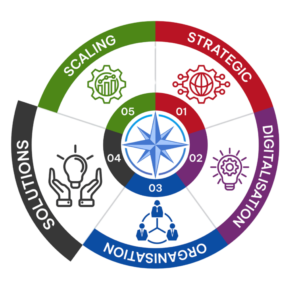
AI becomes valuable when it solves real business problems.
Organizations must identify and prioritize AI use cases that create measurable impact. This means focusing on areas where AI can improve efficiency, enhance quality or generate new business opportunities.
Typical areas for AI use cases include:
- automation of repetitive tasks
- decision support and analytics
- customer service and personalization
- process optimization
The goal is not to apply AI everywhere, but to focus on the use cases that create the greatest value.
-
Scaling and Operations
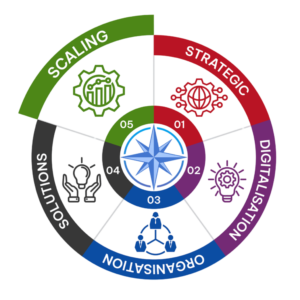
Pilot projects alone do not create value.
For AI to deliver long-term impact, solutions must be integrated into daily operations and supported by clear ownership, governance and operational processes.
Successful scaling requires:
- clear ownership of AI solutions
- integration with existing systems
- governance and risk management
- continuous improvement and monitoring
Organizations that successfully scale AI move from experimentation to operational impact.
Why Many AI Initiatives Fail
Research shows that most AI initiatives fail not because of technology, but because organizations lack strategy, governance or the right operating model.
Companies often underestimate the importance of leadership alignment, organizational readiness and operational integration.
The AI Strategy Compass addresses these challenges by providing a clear structure that connects:
- strategy
- organization
- technology
- implementation
By addressing these dimensions together, organizations can move beyond isolated AI experiments and build a structured and sustainable AI strategy.
From AI Curiosity to AI Strategy
The AI Strategy Compass helps organizations navigate the complexity of artificial intelligence.
Instead of focusing only on tools and technologies, the framework provides leaders with a structured approach to building an AI strategy that creates real business value.
Organizations that apply the AI Strategy Compass gain:
- a clearer strategic direction for AI
- stronger alignment across leadership teams
- better prioritization of AI initiatives
- improved ability to scale AI solutions
The result is a more structured and sustainable approach to AI transformation.